Công ty Luật bizconsult hân hạnh được đóng góp bài viết đăng trên ấn phẩm Asian-mena Counsel In-house Handbook 2020

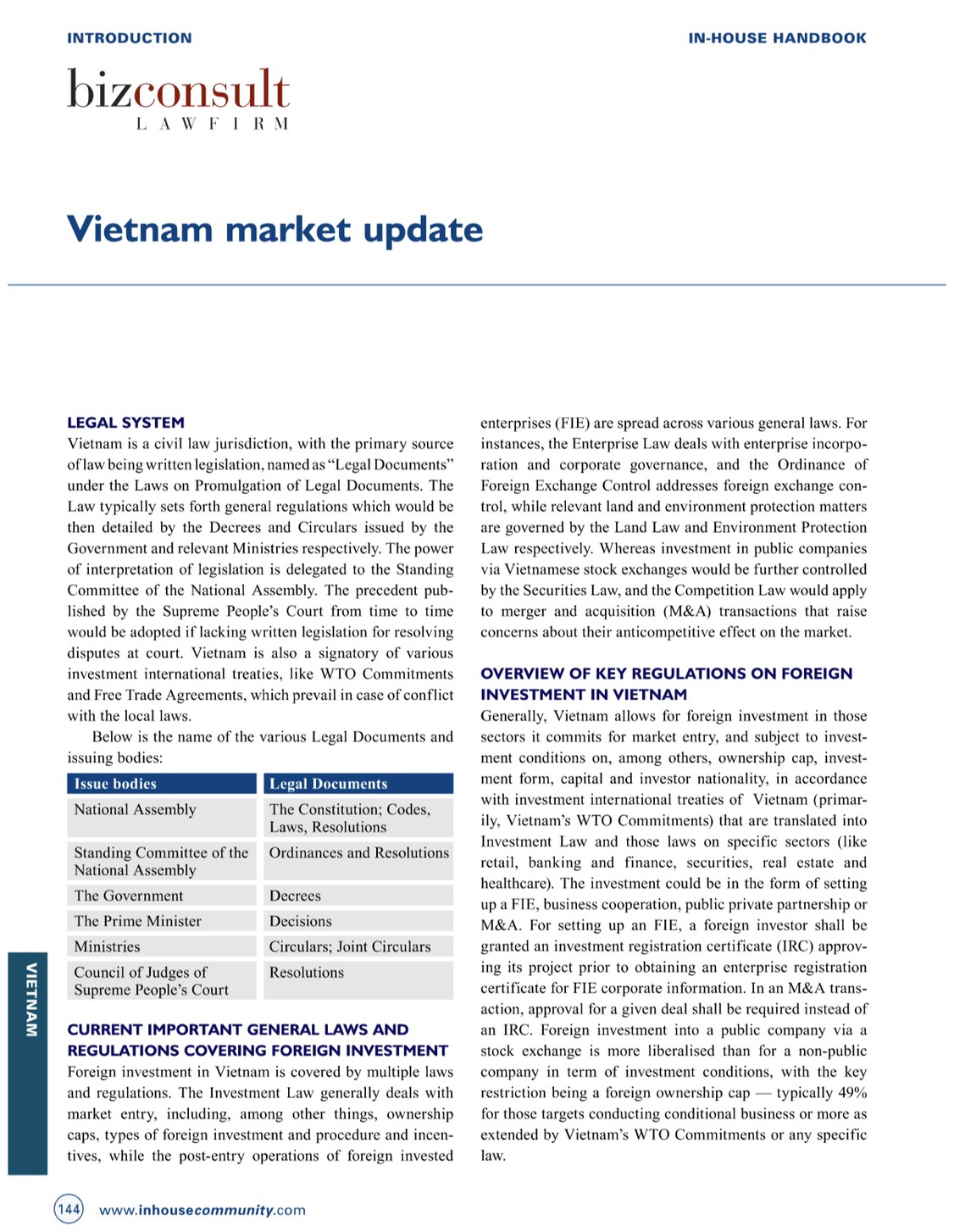
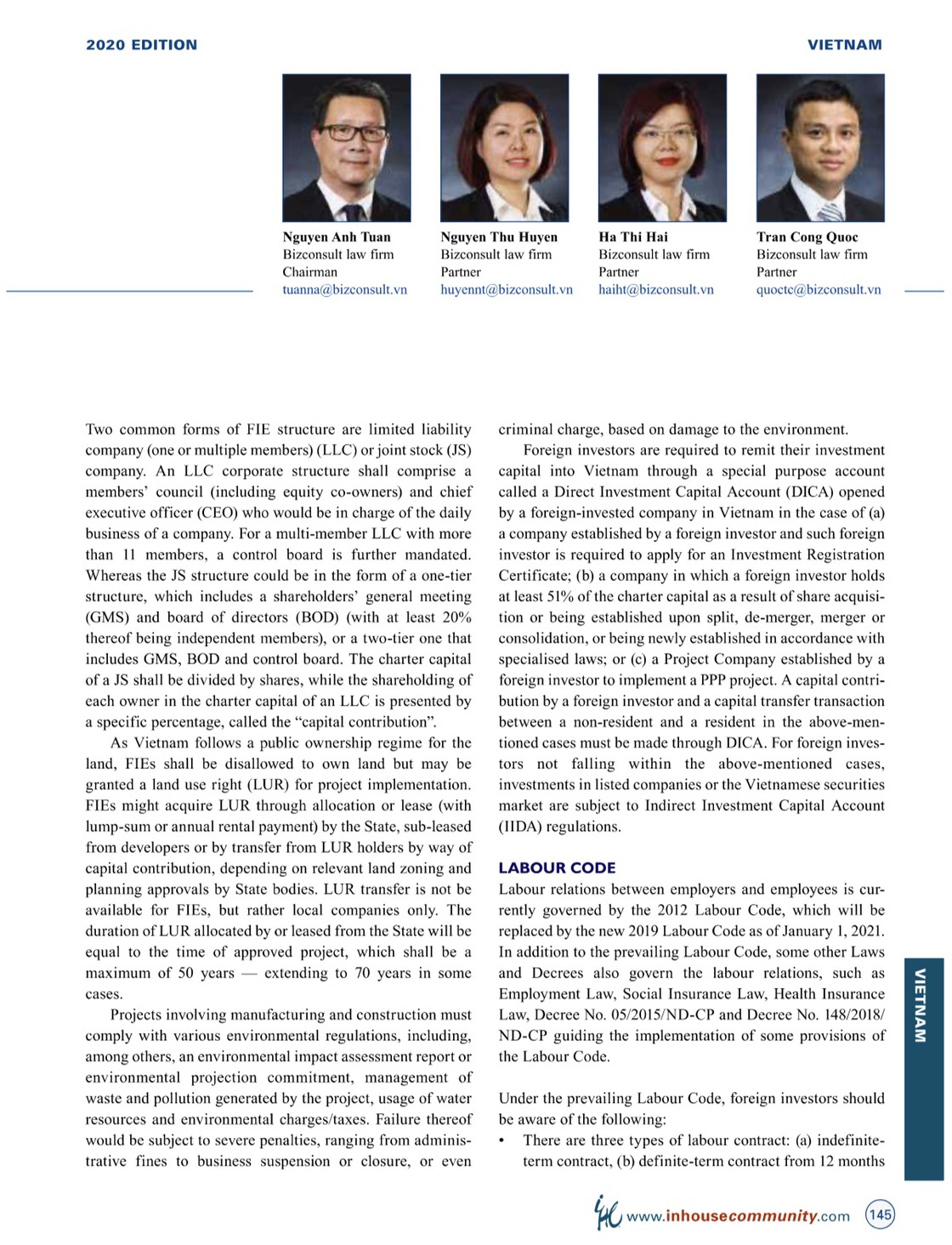
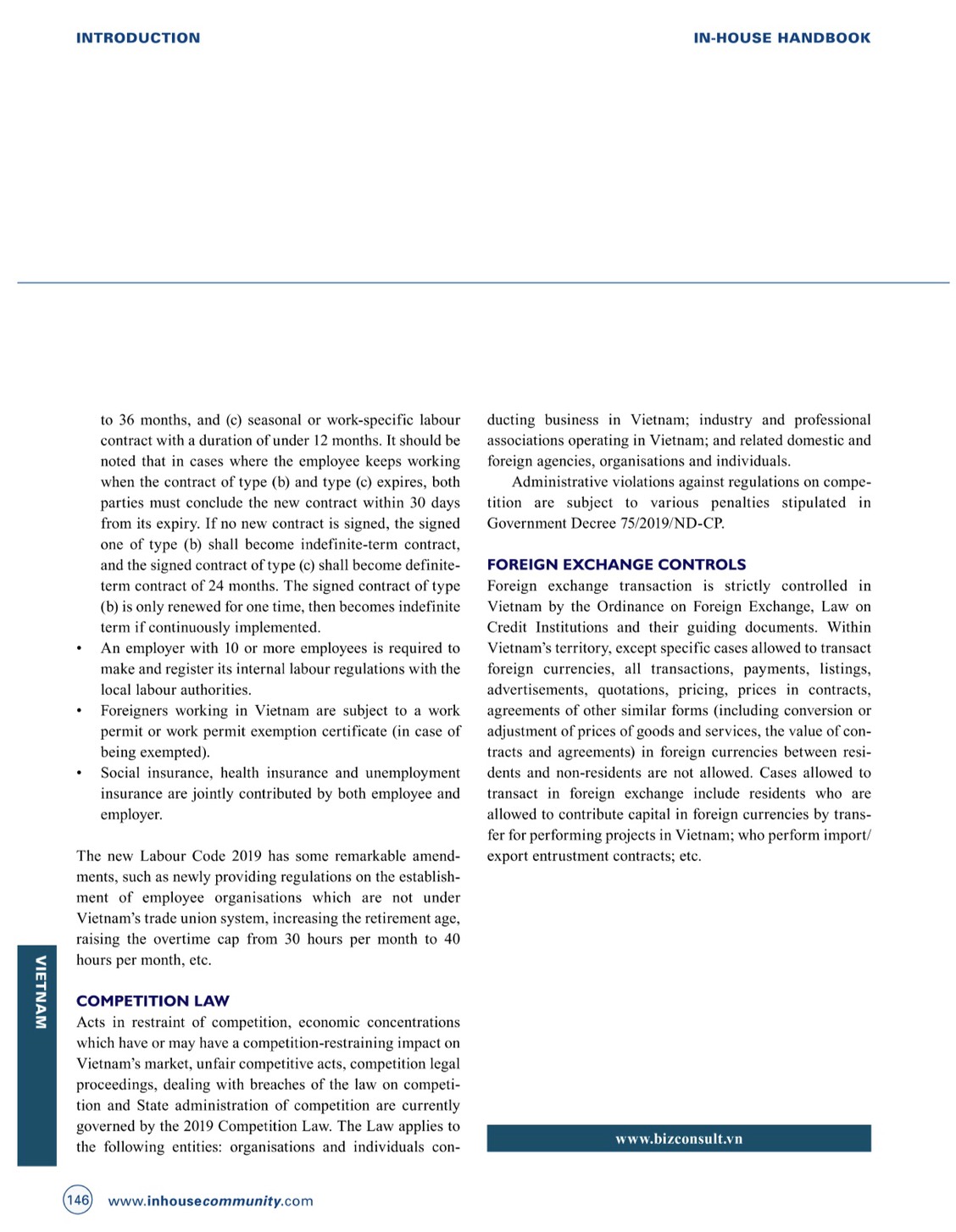
Công ty Luật Bizconsult hân hạnh được đóng góp bài viết “Vietnam market update” đăng trên ấn phẩm Asian-mena Counsel In-house Handbook 2020 thực hiện bởi Luật sư Nguyễn Anh Tuấn – Chủ tịch HĐTV và các Luật sư Thành viên Nguyễn Thu Huyền, Hà Thị Hải và Trần Công Quốc. Bài viết tiếp cận và đánh giá quy định pháp luật hiện hành của Việt Nam trong những lĩnh vực luật quan trọng và cốt lõi nhất mà các nhà đầu tư nước ngoài cần phải lưu ý khi tham gia vào thị trường Việt Nam như luật đầu tư, luật lao động, luật cạnh tranh và các quy định pháp luật liên quan đến giao dịch ngoại hối. Các tác giả hi vọng bài viết sẽ đem đến một cái nhìn toàn cảnh về môi trường pháp lý đầu tư, kinh doanh tại thị trường Việt Nam, một thị trường hứa hẹn tiềm năng phát triển mạnh mẽ nhưng cũng ẩn chứa nhiều thách thức, rủi ro.

Download PDF

https://www.inhousecommunity.com/about-us/publications/asian-mena-counsel-in-house-handbook/


Bizconsult Law Firm is pleased to be the contributors of Asian-mena Counsel In-house Handbook Edition 2020

Bizconsult’s Chairman – Lawyer Nguyen Anh Tuan and bizconsult’s partners namely Lawyer Nguyen Thu Huyen, Lawyer Ha Thi Hai, Lawyer Tran Cong Quoc are pleased to be the contributors of Asian-mena Counsel In-house Handbook Edition 2020’s article “Vietnam market update”. The article offers a holistic approach to Vietnam’s current legal provisions in the most essential law areas that foreign investors need to be aware of when participating in Vietnam market such as investment law, labor law, competition law, provisions on foreign exchange controls.

Download PDF

https://www.inhousecommunity.com/about-us/publications/asian-mena-counsel-in-house-handbook/


VIETNAM: SWEEPING REFORM TO SECURITIES MARKET

Lưu ý: “bài viết này chỉ phát hành tiếng Anh cho tạp chí nước ngoài Asian- Mena Counsel”

By Trang Nguyen  – Associate | Attorney at Law

In November 2019, the National Assembly passed the new Law on Securities No. 54/2019/QH14 (“New Law”), effective from 01 January 2021. The New Law will completely replace the current Law on Securities No. 70/2006/QH11 as amended by the Law No. 62/2010/QH12 (“Current Law”). The New Law is said to be a radical improvement to regulations on securities market in Vietnam, and is expected to overcome those shortcomings observed for the past 10 years.

One of the remarkable points of the New Law is the imposition of stricter qualifications to become a public company. In particular, in order to become a public company, the required minimum paid-up charter capital of a company will be VND30 billion, in which at least 10% voting shares must be held by at least 100 shareholders other than major shareholders. The Current Law requires the minimum paid-up charter capital of a public company to be VND10billion and held by 100 shareholders only. The current public company which fails to reach such conditions after the effective date of the New Law shall be reverted to be non-public.  Alternatively, a non-public company may also become a public company after its successful initial public offering (“IPO”).

With respect to public offering, the New Law set out separately conditions for IPO and follow-on public offer, rather than the same conditions for both under the Current Law. For IPO, the conditions on charter capital, profit and accumulated loss before IPO and minimum voting shares to be offered in an IPO are more stringent than those provided in the Current Law. In particular,

  • The company must have paid-up charter capital of at least VND30billion (VND10billion is required under Current Law);
  • There must be profit in two preceding years (one year is required under Current Law), and no accumulated losses till the year of IPO.
  • At least 15% of the company’s voting shares must be sold (or at least 10% with the company having charter capital of VND 1,000 billion or more) to at least 100 investors other than major shareholders; and
  • Major shareholders must commit to hold at least 20% of the company’s charter capital within at least one year from the completion date of the IPO.

The subscription price shall be deposited on an escrow account during IPO process and be released only upon the completion of IPO. Furthermore, the company’s shares are also demanded to be listed on the Stock Exchange after the IPO. For follow-on public offer, it is required below conditions:

  • The company must have paid-up charter capital of at least VND30billion;
  • There must be profit in preceding year, and no accumulated losses till the year of follow-on public offer;
  • The total par value of offered shares shall not exceed the total par value of outstanding shares, excepting the case that the unsold shares are guaranteed to be subscribed by an underwriter.

If a public offering is to raise capital for project, at least 70% of the total offered shares must be issued. The company must prepare a plan to make up the short fall of the capital intended to be raised from such public offering for the project’s implementation.

Regarding private placement, only strategic investors and professional securities investors are allowed to participate in private placement of a public company under the New Law. The lock-up period will be three years for strategic investors, or one year in case of professional securities investors, except for transfers among professional investors or so ruled by the court/arbitration or in case of inheritance. As compared with the Current Law, the scope of professional investors under the New Law covers further, among others, the company with charter capital over VNDN100 billion, the listed company, individual having securities practice certificate, individual having portfolio of listed shares valued at VND2billion, or individual having yearly taxable income of VND1billion or more.

The New Law also introduce certain new regulations on listing and registration for trading, securities depository, registration of securities, securities settlement and clearance, information disclosure, protection of client’s assets, securities investment funds, and sanctions.

https://www.inhousecommunity.com/article/vietnam-sweeping-reform-securities-market/

Download PDF

Vietnam: Sweeping reform to securities market

By Trang Nguyen  – Associate | Attorney at Law

In November 2019, the National Assembly passed the new Law on Securities No. 54/2019/QH14 (“New Law”), effective from 01 January 2021. The New Law will completely replace the current Law on Securities No. 70/2006/QH11 as amended by the Law No. 62/2010/QH12 (“Current Law”). The New Law is said to be a radical improvement to regulations on securities market in Vietnam, and is expected to overcome those shortcomings observed for the past 10 years.

One of the remarkable points of the New Law is the imposition of stricter qualifications to become a public company. In particular, in order to become a public company, the required minimum paid-up charter capital of a company will be VND30 billion, in which at least 10% voting shares must be held by at least 100 shareholders other than major shareholders. The Current Law requires the minimum paid-up charter capital of a public company to be VND10billion and held by 100 shareholders only. The current public company which fails to reach such conditions after the effective date of the New Law shall be reverted to be non-public.  Alternatively, a non-public company may also become a public company after its successful initial public offering (“IPO”).

With respect to public offering, the New Law set out separately conditions for IPO and follow-on public offer, rather than the same conditions for both under the Current Law. For IPO, the conditions on charter capital, profit and accumulated loss before IPO and minimum voting shares to be offered in an IPO are more stringent than those provided in the Current Law. In particular,

  • The company must have paid-up charter capital of at least VND30billion (VND10billion is required under Current Law);
  • There must be profit in two preceding years (one year is required under Current Law), and no accumulated losses till the year of IPO.
  • At least 15% of the company’s voting shares must be sold (or at least 10% with the company having charter capital of VND 1,000 billion or more) to at least 100 investors other than major shareholders; and
  • Major shareholders must commit to hold at least 20% of the company’s charter capital within at least one year from the completion date of the IPO.

The subscription price shall be deposited on an escrow account during IPO process and be released only upon the completion of IPO. Furthermore, the company’s shares are also demanded to be listed on the Stock Exchange after the IPO. For follow-on public offer, it is required below conditions:

  • The company must have paid-up charter capital of at least VND30billion;
  • There must be profit in preceding year, and no accumulated losses till the year of follow-on public offer;
  • The total par value of offered shares shall not exceed the total par value of outstanding shares, excepting the case that the unsold shares are guaranteed to be subscribed by an underwriter.

If a public offering is to raise capital for project, at least 70% of the total offered shares must be issued. The company must prepare a plan to make up the short fall of the capital intended to be raised from such public offering for the project’s implementation.

Regarding private placement, only strategic investors and professional securities investors are allowed to participate in private placement of a public company under the New Law. The lock-up period will be three years for strategic investors, or one year in case of professional securities investors, except for transfers among professional investors or so ruled by the court/arbitration or in case of inheritance. As compared with the Current Law, the scope of professional investors under the New Law covers further, among others, the company with charter capital over VNDN100 billion, the listed company, individual having securities practice certificate, individual having portfolio of listed shares valued at VND2billion, or individual having yearly taxable income of VND1billion or more.

The New Law also introduce certain new regulations on listing and registration for trading, securities depository, registration of securities, securities settlement and clearance, information disclosure, protection of client’s assets, securities investment funds, and sanctions.

https://www.inhousecommunity.com/article/vietnam-sweeping-reform-securities-market/

Download PDF

New Labour Code taking effect on January 1, 2021

Lưu ý: “bài viết này chỉ phát hành tiếng Anh cho tạp chí nước ngoài Asian- Mena Counsel”

By Nguyen Thu Huyen – Partner, Attorney at law

The participation in the Comprehensive and Progressive Agreement for Trans-Pacific Partnership (CPTPP) and the EU-Vietnam Free Trade Agreement (EVFTA) poses numerous requirements on the reform of laws, including labour laws.

Specifically, the members of the CPTPP and EVFTA are requested to adopt and maintain the rights as set out in the 1998 International Labour Organisation (ILO) Declaration, however, Vietnam is yet to ratify the remaining two core conventions of the ILO, which are Convention No. 87 regarding freedom of association and protection of the right to organise, and Convention No. 105 regarding abolition of forced labour. On that basis, Vietnam’s National Assembly ratified the new Labour Code on November 20, 2019 to replace the Labour Code 2012 and pave the way for the full implementation of the 1998 ILO Declaration. The new Labour Code will officially take effect from January 1, 2021 with the following notable provisions.

Employee representative organizations

The new Labour Code provides regulations on the establishment of employee’s organisations which are not under the system of Vietnam trade unions. Together with trade unions, these organisations are recognised as representing labour collectives at the grassroots level and have the equal rights and obligations as trade unions. In another way, the new Labour Code now recognises the right of employees to set up their own representative organisations to promote and improve the representative efficiency and protection of the rights and interests of the employees in labour relations, to comply with the core Conventions of the ILO as the new provision shows Vietnam’s effort tend to ILO’s Convention No. 87 which is not ratified by Vietnam’s National Assembly and to facilitate the process of international integration.

Nevertheless, this new regulation may place trade unions at a disadvantage due to a decrease in the number of members, especially in the non-state sector, and the role of trade unions may be limited.

Retirement age

The retirement age was a controversial topic in the process of preparing the draft of the new Labour Code 2019 for the National Assembly to ratify. People in favour of retaining the current retirement age argued that the increase of the retirement age might lead to growth in unemployment. Eventually, the retirement age has been amended to increase gradually.

In particular, age of retirement of employees working in normal working conditions is increased from 60 to 62 for males in 2028 and from 55 to 60 for females in 2035. Starting from 2021, the retirement age of employees working in normal working conditions is at 60 years and three months of age for males and 55 years and four months of age for females, then the retirement age shall increase by three months per year for males and by four months per year for females.

This roadmap for increasing the retirement age is considered reasonable as the current retirement age is still low compared to many countries in the world such as Singapore, Japan, Germany, etc. Moreover, the current retirement age was set more than 60 years ago when the average life expectancy of Vietnamese was 45 while it has now grown to 76.6 years.

Overtime cap

One of the remarkable amendments in the new Labour Code is the adjustment in the overtime cap. It has risen to 40 hours per month as compared to 30 hours per month as stated in the Labour Code 2012.

This amendment is for the purpose of meeting business needs and increasing the competitiveness of Vietnamese employees in the context of Vietnam joining CPTPP and EVFTA. In addition, the Labour Code newly stipulates cases for employees to work overtime for no more than 300 hours per year to ensure long-term benefits for employees.

Other noteworthy regulations

Other than the above-mentioned provisions, some noteworthy regulations of the new Labour Code are as follows: (i) an additional one full paid leave day adjacent to National Day raises the number of public holidays to 11; (ii) employees are allowed to unilaterally terminate labour contracts without reasons by notifying in advance within the timeline specified by law; (iii) employers are allowed to unilaterally terminate labour contracts of employees who are absent from work without permission for a total of five consecutive working days or more without requiring the employers to dismiss the employees for termination of labour contracts; (iv) and instead of conducting dialogue at workplaces every three months, the new Labour Code adjusts this regulation to once a year.

https://www.inhousecommunity.com/article/vietnam-new-labour-code-taking-effect-january-1-2021/

New Labour Code taking effect on January 1, 2021

By Nguyen Thu Huyen – Partner, Attorney at law

The participation in the Comprehensive and Progressive Agreement for Trans-Pacific Partnership (CPTPP) and the EU-Vietnam Free Trade Agreement (EVFTA) poses numerous requirements on the reform of laws, including labour laws.

Specifically, the members of the CPTPP and EVFTA are requested to adopt and maintain the rights as set out in the 1998 International Labour Organisation (ILO) Declaration, however, Vietnam is yet to ratify the remaining two core conventions of the ILO, which are Convention No. 87 regarding freedom of association and protection of the right to organise, and Convention No. 105 regarding abolition of forced labour. On that basis, Vietnam’s National Assembly ratified the new Labour Code on November 20, 2019 to replace the Labour Code 2012 and pave the way for the full implementation of the 1998 ILO Declaration. The new Labour Code will officially take effect from January 1, 2021 with the following notable provisions.

Employee representative organizations

The new Labour Code provides regulations on the establishment of employee’s organisations which are not under the system of Vietnam trade unions. Together with trade unions, these organisations are recognised as representing labour collectives at the grassroots level and have the equal rights and obligations as trade unions. In another way, the new Labour Code now recognises the right of employees to set up their own representative organisations to promote and improve the representative efficiency and protection of the rights and interests of the employees in labour relations, to comply with the core Conventions of the ILO as the new provision shows Vietnam’s effort tend to ILO’s Convention No. 87 which is not ratified by Vietnam’s National Assembly and to facilitate the process of international integration.

Nevertheless, this new regulation may place trade unions at a disadvantage due to a decrease in the number of members, especially in the non-state sector, and the role of trade unions may be limited.

Retirement age

The retirement age was a controversial topic in the process of preparing the draft of the new Labour Code 2019 for the National Assembly to ratify. People in favour of retaining the current retirement age argued that the increase of the retirement age might lead to growth in unemployment. Eventually, the retirement age has been amended to increase gradually.

In particular, age of retirement of employees working in normal working conditions is increased from 60 to 62 for males in 2028 and from 55 to 60 for females in 2035. Starting from 2021, the retirement age of employees working in normal working conditions is at 60 years and three months of age for males and 55 years and four months of age for females, then the retirement age shall increase by three months per year for males and by four months per year for females.

This roadmap for increasing the retirement age is considered reasonable as the current retirement age is still low compared to many countries in the world such as Singapore, Japan, Germany, etc. Moreover, the current retirement age was set more than 60 years ago when the average life expectancy of Vietnamese was 45 while it has now grown to 76.6 years.

Overtime cap

One of the remarkable amendments in the new Labour Code is the adjustment in the overtime cap. It has risen to 40 hours per month as compared to 30 hours per month as stated in the Labour Code 2012.

This amendment is for the purpose of meeting business needs and increasing the competitiveness of Vietnamese employees in the context of Vietnam joining CPTPP and EVFTA. In addition, the Labour Code newly stipulates cases for employees to work overtime for no more than 300 hours per year to ensure long-term benefits for employees.

Other noteworthy regulations

Other than the above-mentioned provisions, some noteworthy regulations of the new Labour Code are as follows: (i) an additional one full paid leave day adjacent to National Day raises the number of public holidays to 11; (ii) employees are allowed to unilaterally terminate labour contracts without reasons by notifying in advance within the timeline specified by law; (iii) employers are allowed to unilaterally terminate labour contracts of employees who are absent from work without permission for a total of five consecutive working days or more without requiring the employers to dismiss the employees for termination of labour contracts; (iv) and instead of conducting dialogue at workplaces every three months, the new Labour Code adjusts this regulation to once a year.

https://www.inhousecommunity.com/article/vietnam-new-labour-code-taking-effect-january-1-2021/

Bizconsult tư vấn cho khách hàng kí kết thành công hợp đồng với Tập đoàn Marriott

Hôm nay, ngày 05/02/2020, các luật sư của Công ty Luật TNHH bizconsult đã tư vấn và hỗ trợ một nhà phát triển phần mềm Việt Nam kí kết thành công Hợp đồng Quản lý khách sạn và Hợp đồng Hỗ trợ kĩ thuật với Tập đoàn khách sạn hàng đầu thế giới – Marriott. Giao dịch này được dẫn dắt bởi Luật sư Thành viên Cấp cao Lê Hồng Phong với sự hỗ trợ của Luật sư Cộng sự Huỳnh Hoàng Sang.

THÔNG BÁO TUYỂN DỤNG

Ngày 31 tháng 01 năm 2020

Chúng tôi, CÔNG TY LUẬT TNHH BIZCONSULT, là một trong những công ty luật danh tiếng nhất Việt Nam, được các tổ chức nghề nghiệp quốc tế, như Legal500 Asia Law Firms, Asian Legal Business (ALB), Getting The Deal Through (Tạp Chí Mergers & Acquisitions), Global Legal Experts, Asia IP (Tạp chí Sở Hữu Trí Tuệ Châu Á), asialaw (Tạp chí luật Châu Á) v.v… đánh giá và xếp hạng cao trong nhóm các công ty luật hàng đầu chuyên nghiệp tại Việt Nam trong một số lĩnh vực hành nghề chính như Doanh Nghiệp & Thương Mại, Mua Bán & Sáp Nhập Doanh Nghiệp, Tài Chính & Ngân Hàng, Bất Động Sản & Xây Dựng/Hợp Đồng EPC, Dự Án Đầu Tư (Trong Nước & Nước Ngoài), Sở Hữu Trí Tuệ & Nhượng Quyền Thương Mại, Giải Pháp Tranh Chấp & Tranh Tụng (Trọng Tài, Tòa Án). Khách hàng của chúng tôi là các tập đoàn đa quốc gia, các tổ chức quốc tế, các quỹ đầu tư và các doanh nghiệp trong và ngoài nước. Vui lòng truy cập website: http://www.bizconsult.vn để biết thêm thông tin về chúng tôi.
Nhằm đáp ứng nhu cầu phát triển của Công ty, chúng tôi cần tuyển dụng một số vị trí làm việc tại thành phố Hồ Chí Minh như sau:

1.VỊ TRÍ LUẬT SƯ TƯ VẤN – Số lượng: 01

Mô tả công việc:

• Hành nghề tư vấn pháp luật nói chung;
• Chuẩn bị các nghiên cứu, ghi nhớ pháp luật; dự thảo nội dung tư vấn pháp luật theo yêu cầu của luật sư cấp cao hơn;
• Tham gia viết các bài phân tích pháp luật theo sự phân công của công ty;
• Thực hiện các hỗ trợ cần thiết cho luật sư cấp cao hơn, thành viên của công ty trong việc thực hiện các dịch vụ cho khách hàng.

Yêu cầu:

• Đã được cấp Thẻ luật sư;
• Có tối thiểu 03 năm kinh nghiệm hành nghề tư vấn pháp luật trong các lĩnh vực kinh doanh, đầu tư;
• Kỹ năng làm việc theo nhóm tốt;
• Kỹ năng tư vấn, trình bày, thuyết trình bằng tiếng Việt và tiếng Anh tốt;
• Kỹ năng ứng xử, giao tiếp và giải quyết tình huống tốt;
• Sử dụng các chức năng cơ bản của các phần mềm xử lý văn bản và thuyết trình (MS Word, Excel, Power Point);
• Có trách nhiệm và chịu áp lực cao trong công việc;
• Tốt nghiệp đại học chuyên ngành luật kinh tế loại khá/giỏi, bằng cao học luật sẽ có lợi thế trong đánh giá hồ sơ năng lực tuyển dụng.

Quyền lợi:

  • Được trực tiếp tham gia hỗ trợ xử lý các hồ sơ công việc dưới sự hướng dẫn của các Luật sư Cấp cao của Công ty;
  • Môi trường làm việc chuyên nghiệp, năng động và thân thiện;
  • Được các Luật sư Cấp cao của Công ty hướng dẫn, đào tạo các kỹ năng tư vấn và hành nghề luật sư;
  • Được tham dự các diễn đàn, hội thảo trong nước và quốc tế tổ chức tại Việt Nam nhằm mở rộng kiến thức và quan hệ;
  • Lương theo năng lực/thỏa thuận;
  • Các quyền lợi khác theo quy định của pháp luật lao động và bảo hiểm xã hội;
  • Các phúc lợi theo quy định của Công ty;
  • Cơ hội thăng tiến nghề nghiệp.

2. VỊ TRÍ TRỢ LÝ LUẬT SƯ – Số lượng: 01 

Mô tả công việc:

  • Chuẩn bị các nghiên cứu, ghi nhớ pháp luật; dự thảo nội dung tư vấn pháp luật theo yêu cầu của luật sư cấp cao hơn;
  • Tham gia viết các bài phân tích pháp luật theo sự phân công của công ty;
  • Thực hiện các hỗ trợ cần thiết cho luật sư cấp cao hơn, thành viên của công ty trong việc thực hiện các dịch vụ cho khách hàng.

Yêu cầu:

  • Tốt nghiệp hoặc sinh viên năm cuối chuyên ngành luật đối với vị trí Trợ lý Luật sư. Có kinh nghiệm thực tập hoặc làm việc tại các công ty luật/văn phòng luật sư là lợi thế.
  • Làm việc toàn thời gian.
  • Tiếng Anh 4 kỹ năng tốt, sử dụng thành thạo tin học văn phòng
  • Có khả năng giao tiếp, làm việc nhóm.
  • Trung thực, có tính kỷ luật, tận tâm với công việc.

Quyền lợi:

  • Được trực tiếp tham gia hỗ trợ xử lý các hồ sơ công việc dưới sự hướng dẫn của các Luật sư Cấp cao của Công ty;
  • Môi trường làm việc chuyên nghiệp, năng động và thân thiện;
  • Được các Luật sư Cấp cao của Công ty hướng dẫn, đào tạo các kỹ năng tư vấn và hành nghề luật sư;
  • Được tham dự các diễn đàn, hội thảo trong nước và quốc tế tổ chức tại Việt Nam nhằm mở rộng kiến thức và quan hệ;
  • Lương theo năng lực/thỏa thuận;
  • Các quyền lợi khác theo quy định của pháp luật lao động và bảo hiểm xã hội;
  • Các phúc lợi theo quy định của Công ty;
  • Cơ hội thăng tiến nghề nghiệp

3. HỒ SƠ YÊU CẦU CHO TẤT CẢ CÁC VỊ TRÍ

Thành phần hồ sơ (bằng Tiếng Anh hoặc Tiếng Việt)

  • Đơn xin việc;
  • CV năng lực cho vị trí dự tuyển (có ảnh cá nhân trong 01 năm gần nhất).

Hình thức nhận hồ sơ:

  • Trực tiếp tại Văn phòng Hồ Chí Minh:
  • Phòng 1103, Lầu 11,
  • Sailing Tower, 111A đường Pasteur,
  • Quận 1, Thành phố Hồ Chí Minh, Việt Nam

Liên hệ: Mọi thắc mắc vui lòng liên hệ :

  • Ông Trần Công Quốc: 0934778119


RECRUITMENT ANNOUNCEMENT

31th January 2020

BIZCONSULT LAW FIRM is recognized as one of the most prestigious law firms in Vietnam. We are highly evaluated and ranked in the group of leading professional law firms in Vietnam in some key areas such as Business & Trade, Mergers & Acquisitions, Finance & Banking, Real Estate & Construction/EPC Contracts, Investment Projects (Inbound & Outbound), Intellectual Property & Franchise, Dispute Resolution & Litigation (Arbitration and Court) by international professional organizations such as Legal500 Asia Law Firms, Asian Legal Business (ALB), Getting The Deal Through (Mergers & Acquisitions Magazine), Global Legal Experts, Asia IP (Asian Intellectual Property Magazine), asialaw (Asian Law Magazine), etc… Our clients are multinational corporations, international organizations, investment funds and domestic and foreign enterprises. Please visit our website at: http://www.bizconsult.vn for more information.

In order to meet the demand for the Company’s development, we would like to recruit new vacant positions in Ho Chi Minh City office as follows:

I. POSITION: ADVISORY LAWYER – Quantity: 01

Job description:

  • Doing legal consulting works in general;
  • Doing legal research and preparing legal memorandum; drafting legal advice at the request of senior lawyers;
  • Participating in writing legal analysis as assigned by the Company;
  • Supporting the senior lawyers, Company’s staffs in providing legal services for the clients.

Job requirements:

  • Having Lawyer’s License;
  • Having at least 03 years of legal consultancy experience in the fields of business and investment law,
  • Having good teamwork skill;
  • Having good consulting and presentation skills in Vietnamese and English;
  • Having good manner, communication and problem solving skills;
  • Knowing how to use the basic functions of word processing and presentation software (MS Word, Excel, Power Point);
  • Being responsible and being able to work under pressure;
  • Graduated from law university, economic law field with good/very good grade, master’s degree in law will have advantage in evaluating employment applications.

Benefits:

  • Being directly involved in handling work records under the guidance of the Company’s senior lawyers;
  • Working in a professional, dynamic and friendly environment;
  • Being guided and trained by Company’s senior lawyers in counseling and practicing law skills;
  • Attending national and international forums and conferences organized in Vietnam to expand knowledge and relationship;
  • Salary according to capacity/agreement;
  • Other benefits under the provisions of laws on labor and social insurance;
  • Benefits according to the Company’s regulations;
  • Career advancement opportunities.

II. POSITION: LEGAL ASSISTANT – Quantity: 01

Job description:

  • Doing legal research and preparing legal memorandum; drafting legal advice at the request of senior lawyers;
  • Participating in writing legal analysis as assigned by the Company;
  • Supporting the senior lawyers, Company’s staffs in providing legal services for the clients.

Job requirements:

  • Graduated or being a final year Law student for Legal Assistant position. Having experience in internship or working at law firm’s/lawyer’s offices is an advantage;
  • Working full-time;
  • Being good at four English skills and computer science;
  • Having good communication and teamwork skills;
  • Being honest, disciplined, dedicated to work;

Benefits:

  • Being directly involved in handling work records under the guidance of the Company’s senior lawyers;
  • Working in a professional, dynamic and friendly environment;
  • Being guided and trained by Company’s senior lawyers in counseling and practicing law skills;
  • Attending national and international forums and conferences organized in Vietnam to expand knowledge and relationship;
  • Salary according to capacity/agreement;
  • Other benefits under the provisions of laws on labor and social insurance;
  • Benefits according to the Company’s regulations;
  • Career advancement opportunities.

III. APPLICATION REQUIREMENTS FOR ALL POSITIONS:

Application dossier (in English or in Vietnamese):

  • Job application;
  • CV for the vacant position (attached with a personal photo in the last 01 year).

Submission:

  • Directly at Ho Chi Minh City office:
  • Room 1103,
  • 11th Floor, Sailing Tower
  • 111A Pasteur, District 1,
  • Ho Chi Minh City, Vietnam

Contact: If you have any questions, please contact:

  • Tran Cong Quoc – 0934778119