
LEGAL UPDATE – FEBRUARY 2024 – GUIDANCE ON THE PRIVATE PLACEMENT OF CORPORATE BONDS IN DOMESTIC MARKET

Issue February 2024

Nguyen Thu Huyen
Partner 

Nguyen T. Thu Ha
Senior Associate

Corporate bonds are currently governed by the Decree No. 153/2020/ND-CP dated 31 December 2020 on the private placement of corporate bonds and trading of privately placed corporate bonds in the domestic market and offering of corporate bonds to the international market, as amended and supplemented by the Decree No. 65/2022/NĐ-CP and the Decree No. 08/2023/ND-CP (“Decree 153”).

On 17 May 2023, the Ministry of Finance issued Circular No. 30/2023/TT-BTC guiding a number of the regulations on registration, depository, exercise of rights, transfer of ownership rights, transaction payment, and organization of the market for trading privately placed corporate bonds in the domestic market (“Circular 30”). Circular 30 specifically guides the privately placed corporate bonds (the “Bonds”) issued from 01 January 2021 in accordance with Decrees 153. Regarding Bonds issued prior to 01 January 2021 with the outstanding principle, the bond depository and transaction will continue to be conducted in accordance with the approved bond issuance plan.

1. General Principles 

Circular 30 sets out 08 general principles when implementing the registration, depository, exercises of rights, transfer of rights of the Bonds. Some notable principles are as follows:

  1. The Bonds must be registered and deposited in concentration at the Vietnam Securities Depository and Clearing Corporation – VSDC (Tổng công ty Lưu ký và Bù trừ chứng khoán Việt Nam, in Vietnamese).
  2. The Issuer, the VSDC, and the depository members shall be responsible for exercising the rights for the bondholders in accordance with the Law on Securities and other relevant laws.
  3. The Issuer shall have to register the trading of issued Bonds in the bond trading system.
  4. The payment for transactions in the bonds trading system shall be made via the bonds payment system according to the instant payment method for each transaction, the central clearing partner mechanism shall not be applied.

2. Trading account for trading of the privately placed corporate bonds

This is a new regulation that requires the investors to open a trading account at the trading members for the implementation of transactions.

In case the investor has already had the securities trading account opened at the trading member, the investor is entitled to use such account to trade Bonds. Before the purchase of Bonds, the investors must be a professional investor and have signed a letter of confirmation in accordance with the laws on securities. The Securities enterprises being the trading members are responsible for identifying the professional investor qualification and ensuring that the investors are eligible for bonds purchase before entering commands into the bonds trading system.

3. Trading the corporate bonds via the bond trading system opened at Hanoi Stock Exchange

Circular 30 particularly releases a “life jacket” for the bondholders under the current circumstances where there are several issuers being unable to repay both principal bond and interests under the Bonds. The investors may directly offer their Bonds through the corporate bond trading system opened at the Hanoi Stock Exchange to recover their investment costs. So what are the conditions for investors to be able to offer their Bonds?

First, the issuer must register the Bonds at the VSDC. Secondly, before being traded or transferred to others, the Bonds must be deposited in concentration at the VSDC through a securities enterprise. Thirdly, and being the most crucial factor, is to find investor willing to purchase the Bonds.

In such cases, the Bonds shall be transferred and traded on the bond trading system via the mutual agreement of the parties. Such transaction is established when the buyer or seller enters a trading command into the bond trading system and the reciprocal party confirms that trading command.

4. Transfer of bond ownership rights

The VSDC shall transfer the Bonds that have been registered and deposited at its corporation via the bonds trading system. However, Circular 30 further guides some special circumstances where the transfer of Bonds ownership rights is not subject to bond trading system, such as donation, inheritance; division, separation, consolidation, merging, dissolution of enterprises; exercises of courts’ judgment, decisions of arbitration court or the judgment enforcement; etc.

5. Payment settlement of bonds transaction

Circular 30 sets forth more detailed instructions on bond transaction payment. Accordingly, individuals and organizations eligible for Bonds transactions on the depository account system of the VSDC includes: (i) the depository members settling payment for their own Bonds transactions or their clients’ and (ii) the organizations opening accounts for the direct payment of their own Bonds transactions (the “Permitted Bond Transfer Organization”). The Permitted Bond Transfer Organization must open a deposit account under its name at the bank for the payment settlement of bond transactions.

The payment of bond transactions shall be made at the settlement bank based on the payment obligation announced by the VSDC. The transfer of bond payments, on the other hand, shall be made via the system of VSDC on the principle of Bond transfer between accounts of investors at the Permitted Bond Transfer Organization, simultaneously with the payment settlement at the bank. The depository members at which the investors open their accounts are responsible for the distribution of money and Bonds to the investors’ accounts immediately upon the completion of payment transfer by VSDC and payment settlement of transactions by the bank.

In addition, Circular 30 also prescribes instructions for processing some circumstances of insolvency for bond transactions, for instance, where the Permitted Bond Transfer Organization is temporarily insolvent, the bank shall lend money for the payment settlement of bonds transactions by virtue of the financial support agreement signed between the parties. In the event such agreement prescribes the use of deposited securities at VSDC as collaterals for the loan amount, VSDC shall freeze such securities under the suggestion of the bank. Furthermore, in case the payment deadline arrives and the Permitted Bond Transfer Organization does not have available funds for such payment, VSDC shall remove the transaction payment.

Download pdf version

[AWARDS AND ACCOLADES] The A-list: Vietnam’s Top 100 Lawyers 2023

bizconsult Law Firm is proud to announce that 2023 is the fourth consecutive year that three of its Partners: Mr. Tuan Nguyen, Mr. Viet Nguyen, and Mr. Phong Le have been listed in the A-list of 100 lawyers notable for their adherence to best practices in Vietnam by the Asia Business Law Journal.

This list is forged from extensive research and nominations from in-house counsel primarily in Vietnam, but also Vietnam-focused partners with international law firms. Comments submitted to Asia Business Law Journal by the clients underscore their preference for seasoned lawyers who consistently uphold the highest ethical standards and maintain professionalism and enthusiasm in their interactions.

Read more at https://law.asia/vietnam-top-lawyers/

_______________________________________

For more information, please refer to http://www.bizconsult.vn/

LEGAL UPDATE – FEBRUARY 2024 – LAW ON PRICE 2023

Issue February 2024

Trinh Hoang Lien
Partner 


Ha T. Thu Trang
Legal Assistant


The Law on Price No. 16/2023/QH15 (“Law on Price 2023“) was adopted by the National Assembly on June 19, 2023 to overcome limitations under the Law on Price 2012 to adapt with drastical changes in reality. The law will take effect on July 01, 2024 except for the provisions on the expertise of the Valuer Council, which will be delayed until January 01, 2026. Below are some notable new points of the Law on Price 2023.

1. Principles of applying the Law on Price and other related laws

Application of the Law on Price on issues concurrently regulated by other effective laws is guided in more detail under the Law on Price 2023. Specifically, in case there are inconsistancies between the Law on Price and other laws issued before the effective date of the Law on Price, the Law on Price shall be applied, except for pricing by the State of some commodities required to implemented in accordance with the lining laws, including laws on land, housing, electricity, medical examination, treatment, education, university education, vocational education and intellectual property.

2. Price declaration

The Law on Price 2023 expands numerous cases subject to price declaration besides the mandatory case of declaring prices for goods and services in the price stabilisation list as regulated under the Law on Price 2012. Goods and services subject to price declaration include goods and services in the price stabilisation list; goods and services that the State determines the price range, maximum price, minimum price for organisations to determine specific prices to sell to consumers; goods and services that traders agree to follow the reference price; and other essential goods and services determined by the Government.

It is concerned that expansion of the subjects of price declaration can become a form of “sub-license” for traders of goods and services. The list of organisations providing goods and services that must perform price declaration is unclear. Price declaration shall be implemented at two levels, the Ministrial level and equivalent agency and the provincial level (Provincial People’s Committee) according to the list issued by these agencies. The questions whether the price declaration procedure is complicated or not, the list of organisations subject to price declaration is long or not and if there will be overlap in the list of goods and services subject to price declaration issued by these two levels of implementation or not only be answered upon the promulgation of Decree guiding in detail by the Government.

3. Business conditions for valuation services of valuation enterprises

The conditions for valuation services of valuation enterprises are regulated more strictly to ensure the stability of human resources of valuation enterprises and limit violations in the implementation process. The new regulation increases the requirement for the minimum number of valuers at enterprises from 3 to 5 valuers.

Furthermore, additional requirements are set for each form of valuation enterprise. Specifically, for partnership company, general partners of the partnership must be persons who obtains valuer card registered for the valuing profession at the enterprise. For limited liability company with two or more members and joint stock company, it is further required that the total contributed capital of the members or shareholders who have an valuer card registered for the valuing profession at the enterprise must account for more than 50% of the charter capital of the enterprise.

For the branch of the valuing enterprise, the new regulation requires to increase the number of valuers at the branch of the valuing enterprise from at least 2 to at least 3 valuers who meet all conditions for registering for the valuing profession and registering for the valuing profession at the branch.

4. Conditions for valuers

The Law on Price 2023 reduces the working experience time required before register for the valuing profession for those who gain university degree or higher in the field of price or valuation according to the application-oriented program as prescribed by law. For these persons, the minimum total actual working time at the valuation enterprises, state management agencies on price and valuation is 24 months compared to the general level of total actual working time at the valuation enterprises, state management agencies on price and valuation for those with a general university degree or higher of 36 months.

5. List of goods and services subject to price stabilisation

The Law on Price 2023 removes electricity, table salt and table sugar (including granulated sugar and refined sugar) from the list of goods and services subject to price stabilization regulated by the Law on Price 2012 and adds DAP fertilizer, animal feed and aquatic feed. Consequently, the list of goods and services subject to price stabilisation according to the Law on Price 2023 includes 9 goods and services: Gasoline, oil products; Liquefied petroleum gas (LPG); Milk for children under 6 years old; Ordinary paddy and rice; Nitrogen fertilizer, DAP fertilizer, NPK fertilizer; Animal feed, aquatic feed; Vaccines for disease prevention for livestock, poultry; Pesticides; Drugs in the list of essential drugs used at medical examination and treatment facilities. The regulation of this list in the law ensures transparency, clarity, avoids abuse to expand the scope of goods subject to price stabilisation, ensures legal certainty, stability, helps businesses and people who are doing business in goods subject to price stabilisation have a suitable business plan.

6. List of goods and services subject to price determination by the State

The Law on Price 2023 supplements a criterion for goods and services subject to price determination by the State, essential goods and services of monopoly nature in buying and selling or have a limited competitive market and affect the economy – society, people’s lives, production and business activities. Additionally, in order to get rid of inconsistancy, overlap between the Law on Price and other lining laws in related to goods and services subject to price determination by the State, the Law on Price 2023 also updated the list of goods and services subject to price determination by the State in line with the regulations of lining laws such as adding station entry and exit services; auction services, … to the list.

Download pdf version

LEGAL UPDATE – JANUARY 2024 – WHAT ARE THE IMPACTS OF NEW LAND LAW 2024 ON PROPERTY/ REAL ESTATE DEVELOPERS IN LAND PRICE EVALUATION?

Special Issue Jan, 2024

Nguyen Dang Viet
Partner

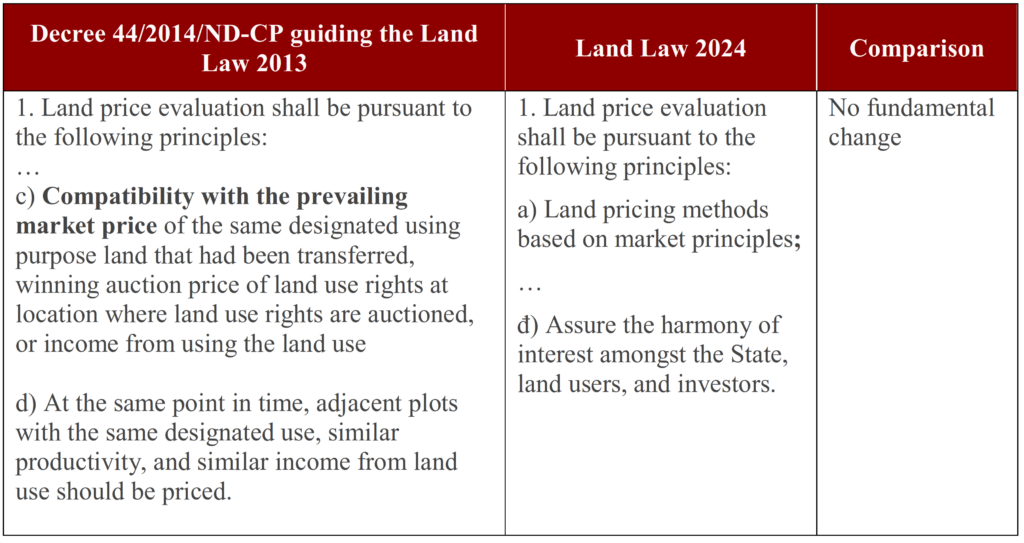
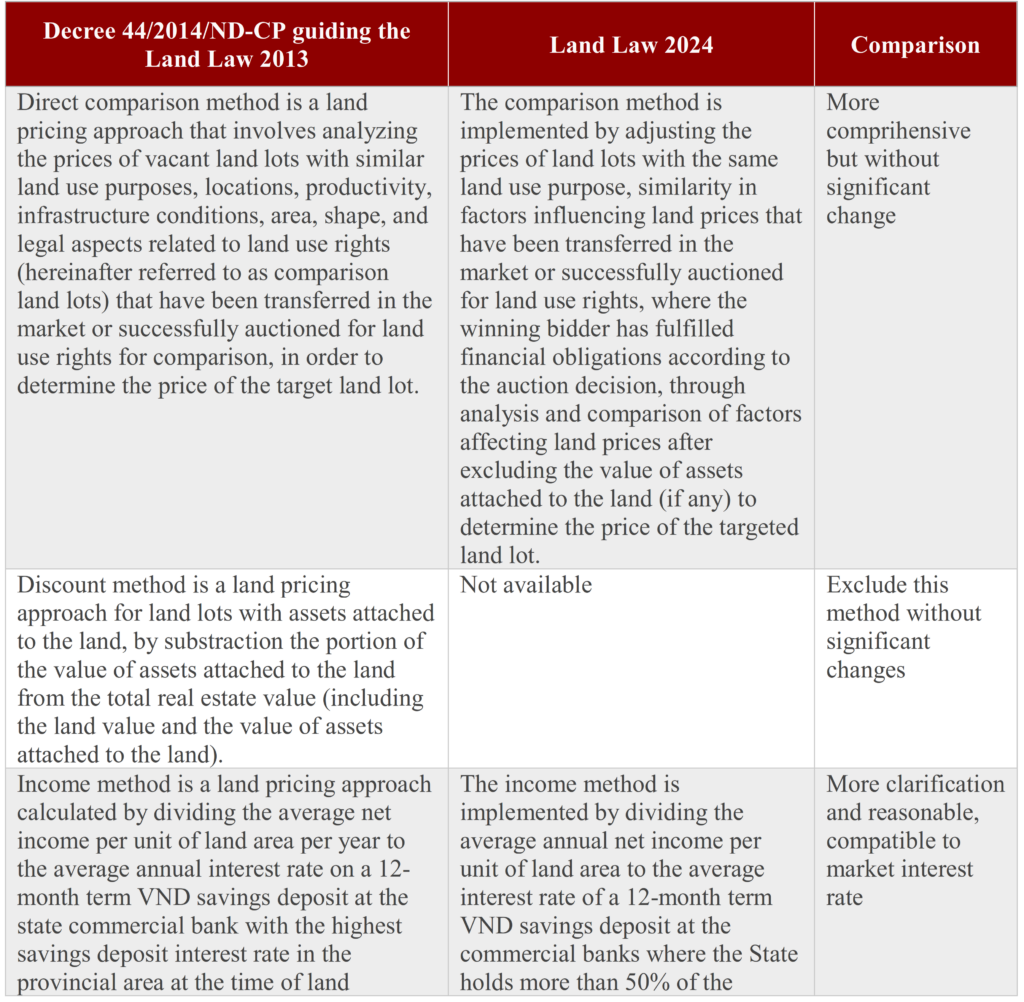
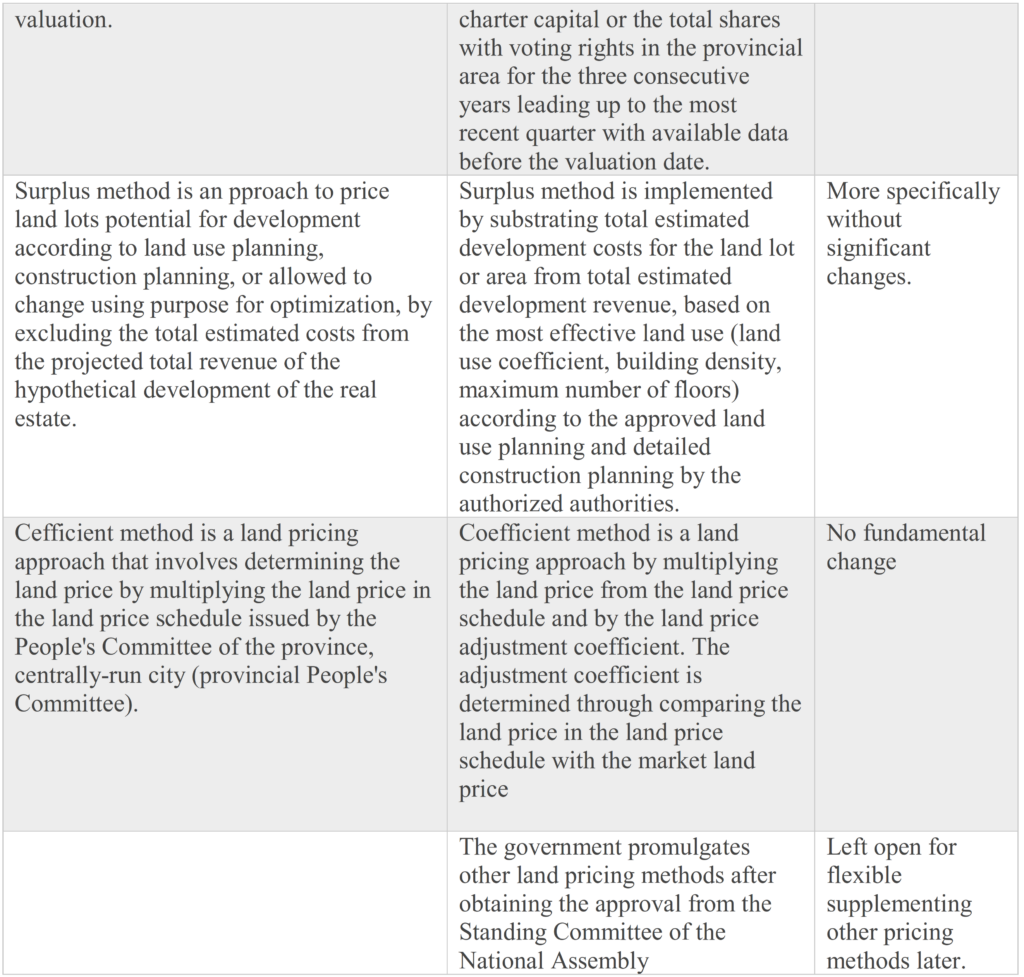
We take a snapshot on amendments and supplements under the new Land Law 2024 related to land pricing and evaluation, a very important issue concerned by all real estate developing investors to find out whether there are significant impacts on land costs leading to changes in real estate selling prices or not.

I – Principles of land pricing

II- Land Price Evaluation Approaches

Download pdf version

Partner Viet Dang Nguyen wins Lexology’s 2024 Client Choice Awards

29 November 2023

Congratulations on Partner Viet Dang Nguyen’s winning the Lexology’s Client Choice Awards 2024 (Recongnizing Excellence In Client Service in M&A). He has been recognized as a winning recipient based on excellent reviews from clients, amongst 2,500 nominations by corporate counsels for these awards just one expert is recognized by Lexology within a category/jurisdiction per year.

Viet practices laws in Vietnam since 2000 and is regarded as amongst the best in Vietnam. He heads Bizconsult Law Firm as a senior partner with his decades of experiences in major areas of practice in corporate & commercial, M&A, banking & finance, real estate, construction, litigation, labour & employment.

Established in 2005, The Lexology’s Client Choice Award recognizes firms and individuals who stand apart for their excellent client care and the quality of their work. The criteria for recognition focus on an individual’s ability to add value to clients’ work. Clients rate individuals on the following service criteria, among other things: quality of advice, industry knowledge, strategic thinking, responsiveness, effective communication, project management, loyalty, and ethics. For more information please Lexology profile.


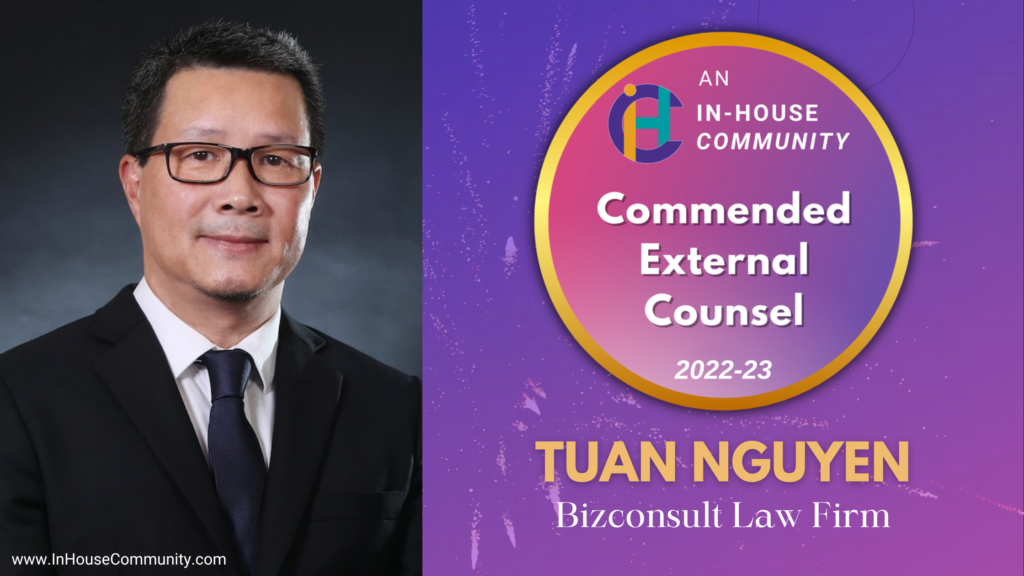
Managing Partner Tuan Anh Nguyen is Recognised at “In-House Community’s Commended External Counsel of the Year, 2022-23”

23 November 2023

We are proud to inform that Mr. Nguyen Anh Tuan, Managing Partner of bizconsult Law Firm has been selected as an ‘In-House Community’s Commended External Counsel of the Year, 2022-23’. His recognition is a direct result of the positive votes and testimonials from in-house counsel and other buyers of legal services. The votes and testimonials were gathered via annual survey of in-house counsel in Asia, and Middle East from March 2022 to September 2023, with comprehensive research from In-House Community.

LEGAL UPDATE – JUNE 2023 – VIETNAMESE GOVERNMENT’S DECREE NO. 08/2023/ND-CP DATED MARCH 5, 2023 AMENDING AND SUSPENDING SOME ARTICLES OF DECREES PRESCRIBING PRIVATE PLACEMENT AND TRADING OF PRIVATELY PLACED CORPORATE BONDS IN DOMESTIC MARKET AND OFFERING OF CORPORATE BONDS IN INTERNATIONAL MARKET

Issue June 2023

Nguyen Thi Thu Trang
Counsel

Phan Van Huy
Senior Associate

Recently, a number of bond issuers, especially those engaged in real estate business, have faced difficulties meeting their due bond principal and interest repayment obligations. With the purpose to facilitate issuers as well as providing more options for bondholders, on 5 March 2023, the Government issued Decree No. 08/2023/ND-CP amending, supplementing and suspending the effect of a number of articles in the Decrees prescribing private placement and trading of privately placed corporate bonds in domestic market and offering of corporate bonds in international market (“Decree 08/2023”).

Decree 08/2023 is expected to bring positive solutions for bond issuers and bondholders in payment of due bonds. The Decree takes effect from the date of signing and marks following significant points:

 1. Allowing negotiation to pay principal and interest of due bonds with other assets

Formerly, the bond issuer is responsible to “make full and timely payments of bond principal and interests when they become due, and exercise associated rights (if any) for bondholders under terms and conditions of bonds” as stipulated in  Article 34.3 of Decree No. 153/2020/ND-CP of the Government prescribing private placement and trading of privately placed corporate bonds in domestic market and offering of corporate bonds in international market (“Decree 153/2020”), with no regulation allowing adjustment of the payment term. Decree 08/2023, notably, provides regulations allowing the issuers and bondholder to negotiate to pay due principal and interest of bond with other assets. In particular, regarding bonds offered for sale in the domestic market, where the issuers cannot make full and timely payment of the bond principal and interest in Vietnam dong in compliance with the issuance plan announced to the investors, the issuers may negotiate with the bondholders to pay due principal and interest of the bond with other assets on the following principles:

(i) comply with the provisions of civil law and relevant laws. For conditional business lines, they must also comply with the provisions of respective law on such conditional business lines;

(ii) must be approved by the bondholders;

(iii) issuers must disclose unusual information and take full responsibility for the legal status of assets used to pay bond principal and interest in accordance with the laws.

This new legal framework is expected to motivate bond issuers that are having difficulty paying bond principals and interests according to the issuance plan announced to investors and, together with bondholders, to find a solution to settle the payment of due bond principal and interest. On the other side, the new regulation opens up more options for bondholders to receive payment with other assets instead of long waiting for the issuers to pay in compliance with the initial plan.

However, it should be noted that this new legal framework only stipulates that the issuers are fully responsible for the legal status of the assets used for payment, but does not provide a strict mechanism to control the legality of the assets and subsequent payment process. Many argue that the change of payment assets can pose issues to asset valuations, asset divisions, notably under circumstances where many bondholders receive payment with the same real estate.

2. Extending bond’s term up to 02 years compared to the announced issuance plan

For bonds issued prior to and having outstanding balance by 16 September 2022 – the effective date of Decree No. 65/2022/ND-CP amending and supplementing a number of articles of Decree No. 153/2020 (“Decree 65/2022”), instead of not allowing issuers to change the term of issued bonds as prescribed in Article 3.3.(b) of Decree No. 65/2022, Decree 08/2023 allows the change of the terms and conditions of bonds on the condition that it must ensure the following principles:

(i) approved by a competent authority of the issuers;

(ii) accepted by bondholders representing at least 65% of the total outstanding bonds of the same type;

(iii) where the bond’s term is extended, the maximum duration shall not exceed 02 (two) years compared to the term in the bond issuance plan announced to investors;

(iv) for bondholders who do not agree to change the bond’s terms and conditions, the issuers are responsible for negotiation to ensure the interests of the investors. Where a bondholder does not accept the negotiation plan, the issuers must fulfill all obligations towards the bondholder according to the bond issuance plan announced to investors (even if the change in terms and conditions of bonds has been approved by bondholders representing 65% or more of the total bonds).

Accordingly, the notable new point is the extension of the bond’s term up to 2 years compared to the term in the bond issuance plan announced to investors. This period shall give the issuers more time to fulfill its obligations towards bondholders.

3. Suspending the effect of some regulations until the end of 2023

Decree 08/2023 further suspends the effect of the following provisions in Decree 65/2022 until the end of 31 December 2023:

(i) Regulations on determining the status of individual professional stock investors at Article 8.1.(d) of Decree 153/2020 as amended in Article 1.6 of Decree 65/2022;

(ii) Regulations on bond distribution time of each issuance instalment in Article 1.7 and 1.8 of Decree No. 65/2022;

(iii) Regulations on credit rating results for bond issuers at Article 12.2.(e) of Decree 153/2020 as amended in Article 1.9 of Decree No. 65/2022.

The suspension of the above regulations is considered a short-term measure to help issuers facing difficulties in liquidity and payment of due bonds due.

To sum up, Decree 08/2023 provides new mechanisms for bond issuers to negotiate with bondholders to solve the current challenging situation of the domestic corporate bond market. Generally, to be able to change the payment assets and extend the bond’s term, the issuers must obtain the approval of the bondholders. Thus, bondholders are advised to carefully consider before making their decisions in the context where many issues may arise in regards to asset valuation, division of assets of co-ownership or the issuers’ provision of unclear or inaccurate information.

Download pdf version

LEGAL UPDATE – MAY 2023 – CHANGES IN LAND REGULATIONS

Issue May 2023

Nguyen Dang Viet
Partner

Nguyen Tu Oanh
Associate

On 03 April 2023, the Government issued Decree No. 10/2023/ND-CP amending and supplementing a number of articles of Decrees guiding the implementation of the Land Law. (“Decree 10/2023”), taking effect from 20 May 2023.

The Decree 10/2023 is considered, amongst 04 other Decrees, significantly affecting the land sector and real estate market. the Decree 10/2023 aims to solve and remove certain difficulties and obstacles in land procedures, land valuation, and granting certificates of land use rights, ownership rights for non-residential real estates (condotel and villas and office real estate, etc.). In particular, the Decree 10/2023 sets out the following noteworthy new provisions:

 1. Extension of land use period shall exclude force majeure affection time

Article 64.1.(i) of the  Law on Land 2013 stipulates that “…If [project] developers still fail to put the land into use when the extended time is over, the State shall revoke the [allocated] land without compensation for land and land-attached assets, except due to force majeure”. Force majeure events had been specifically stated under Article 15.1 of the Decree 43/2014/ND-CP, however, this Decree is silent on handling the consequences of force majeure events. The Decree 10/2023 has now supplemented that the period of time being affected by a force majeure event shall be excluded and added into the 24 months’ grace period.

The following authorities have power to determine the period of force majeure effects: (i) Provincial People’s Committees for projects located in a province/ centrally-affiliated city and (ii) the Minister of Natural Resources and Environment for projects located in two or more provinces or centrally-affiliated cities.

2. Auction of land use rights

Article 119 of the Law on Land 2013 sets out only basic conditions for auctioning and entities to take part into land auction when the State allocates or leases land.

The Decree 10/2023 supplements Article 17.a on auction of land use rights when the State allocates land with collection of land use fees or leases land:

 (i) Conditions for organizations participating in the auction of land use rights: If two or more companies having cross-ownership participate in auction of a parcel of land or a project sited at one or more parcels of land, only one company is allowed to participate in the auction; the deposit requirement is increased to 20% of starting price of the land parcel(s); and companies must satisfy the conditions prescribed by the law on housing and the law on real estate business in order to attend the auction of land for developing housing and other real estate business projects;

(ii) Conditions for land: apart from the conditions specified in Article 119.1 of the Law on Land, the following conditions must also be satisfied: (a) starting price of the auction is determined by a competent state authority; (b) process of auction is applicable to each single parcel; (c) The detail planning 1/500 of the parcel used for development of a housing construction project is approved by a competent authority.

Furthermore, Article 17.a also clearly stipulates on handling deposit in specific cases.

3. Issuance of certificates for condotels

The issuance of certificates of ownership of non-residential construction works, namely condotel, villas, etc., had been guided by the Minister of Natural Resources and Environment in the Official Letter. No. 703/BTNMT-TCQLDD dated 14 February 2020 (“Official Letter 703”). Accordingly, Official Letter 703 referred to Article 32 of Decree 43/2014/ND-CP on certification of ownership of non-residential construction works. However, Article 32 of Decree 43/2014/ND-CP does not have specific regulations on construction works used for travel accommodation purposes.

 The Decree 10/2023 has supplemented Article 32.5 of the Decree 43/2014/ND-CP expanding its application to construction works used for travel accommodation purposes. This regulation clearly states that: “For construction works developed to serve travel accommodation purposes on commercial or service land as prescribed in laws on tourism, if the construction works satisfy the conditions set forth in laws on land, laws on construction and laws on real estate business, the ownership of such construction works attached to land can be granted certificates for commercial or service land use purposes.”. Nonetheless, we view that the Decree 10/2023 has yet to specify whether a developer of a project who develops construction works used for travel accommodation purposes can transfer a single construction work (ie. a condotel or villa) to other organizations or individuals, as in fact, such a transfer may lead to distortion of the original investment project granted to the developer, and whether the transfer is considered a transfer of a part of the investment project or not.

The regulation clearly states that owner of construction work used for travel accommodation purposes take legally responsibility to meet all conditions under the law on construction and real estate business, but it does not prescribe whether or not to comply with the law on investment.

4. Authority to issue title certificates

Currently, the Decree 43/2014/ND-CP, as amended and supplemented by the Decree 01/2017/ND-CP stipulates that: For localities in which Land Registration Offices have been established, the Department of Natural Resources and Environment is the competent agency to grant certificates of land use rights and ownership of houses and other land-attached assets to land users and owners of land-attached assets (“Certificate”) in the following cases: (i) When land users or asset owners exercise the rights of land users or owners of land-attached assets, which requires the grant of a new Certificate; (ii) Renewal or re-grant of Certificates.

The Decree 10/2023 has amended the authority to issue Certificates or to confirm changes to the issued Certificates in a manner that create favorable conditions for people in carrying out these administrative procedures (being implemented at Land Registration Offices without having to go to the Department of Natural Resources and Environment).

5. Online land administrative procedures

Article 1.7 of the Decree 10/2023 provides clearer guidance on procedures for registration and issuance of Certificates in the electronic environment.

The applicants of some land related administrative procedures are now able to undertake online and receive the results of issuing documents by post without having to go directly to the competent authorities. This regulation will help saving time and costs.

6. Conditions for conversion of use purpose of land for rice cultivation, protective forest land, and specialized use forest land to implement investment projects

Regarding the conversion of use purpose of land to implement investment projects as to land for rice cultivation, forest land, etc., Article 1.9 of the Decree 10/2023 has supplemented Article 68.a of Decree 43/2014/ND-CP on conditions and criteria for the conversion of use purpose of land, notably:

  • Having alternative afforestation plans or written document confirm completion of obligations to pay for alternative afforestation in accordance with the laws on forestry in case of the conversion of use purpose of protection forest or special-use forest land or ; having topsoil use plans and written document confirming completion of obligations to pay for protection and development of land for rice cultivation in accordance with the laws on crop production in case of the conversion of use purpose of land for rice cultivation.
  • Having a preliminary environmental impact assessment and environmental impact assessment in accordance with the law on environmental protection (if any).

7. Application dossier for granting Certificates in housing development projects, real estate business projects other than housing development projects

For housing development projects, after the completion of the construction, the investors shall no longer be responsible for submitting the Report on project implementation to the Department of Natural Resources and Environment. This regulation is possibly to reduce administrative procedures, given that there is already procedure for inspection and acceptance of the construction completion to be put into use.

For real estate business projects other than a housing development projects, after completion of construction, the investors shall be responsible for sending the Notification of specialized construction authority that allows investors to conduct taking-over of construction items, construction work or approve the result of taking-over in accordance with laws on construction together with other papers.

Download pdf version